
Signs You're Using Too Many Skincare Products
Signs You're Using Too Many Skincare Products
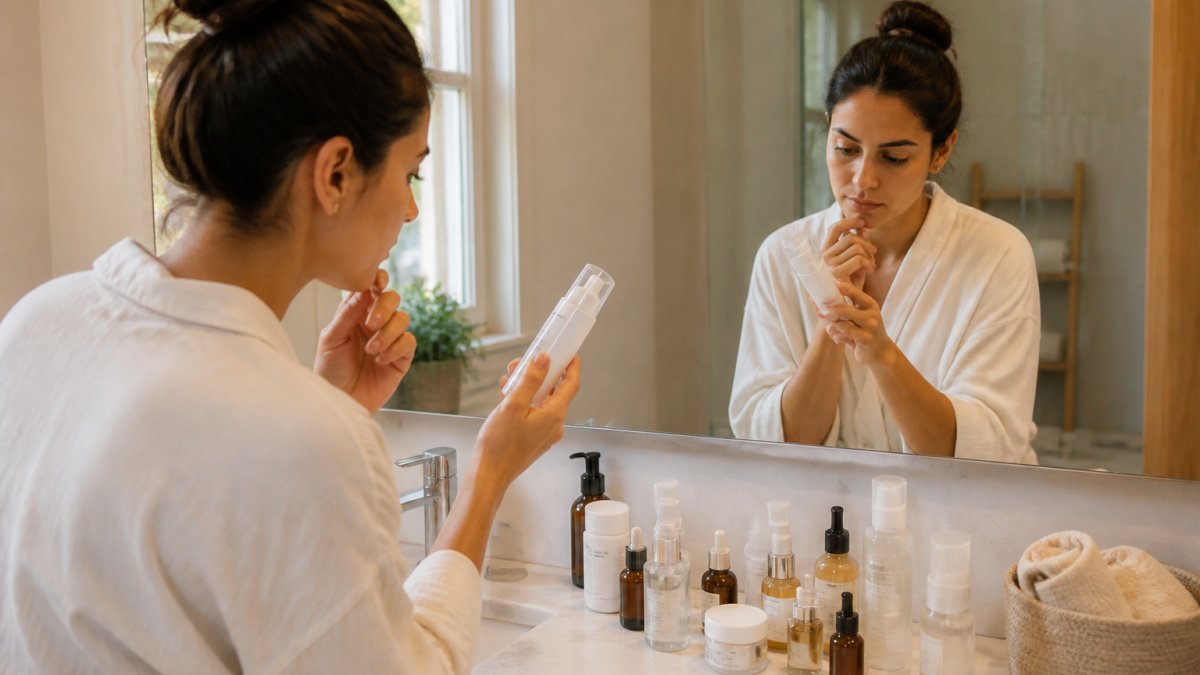
Your bathroom counter looks like a dermatology clinic: serums, essences, toners, treatments, moisturizers, and oils lined up in military precision.
This is the moment most people realize they're using too many skincare products.
The problem isn't that these products are bad individually. Every acid, retinoid, vitamin C, or peptide asks your skin to adapt.
Skin irritation, redness, and sensitivity
Persistent redness and irritation signal that something in your routine has crossed the line.
This happens because your skin barrier, the outermost layer that protects against environmental stress and moisture loss, becomes compromised. Active ingredients penetrate more aggressively when the barrier is weakened, so even gentle products can trigger irritation.
The key distinction: irritation from product overload feels immediate and widespread, not localized to one area. It doesn't come and go with weather changes.
Dryness, tightness, peeling, and flaking
Counterintuitively, too many skincare products often causes excessive dryness. Adding more moisturizer won't help, because the problem runs deeper.
When your barrier is damaged from routine overload, it loses its ability to retain moisture and water evaporates faster than normal.
Peeling and flaking are red flags that your barrier function has declined significantly: your skin sheds surface cells faster than normal because the protective layer underneath is compromised.
New breakouts or clogged pores
Breakouts that appear suddenly, especially if your skin was clear before, often indicate product overload, through two mechanisms.
First, layering multiple products creates an occlusive environment, so pores become congested because too many ingredients sit on the surface.
Breakouts from routine overload tend to be widespread rather than localized, appearing across your face rather than in one trouble zone. They often feel tender and inflamed rather than just comedonal (blackheads or whiteheads).
Stinging or burning when applying familiar products
This is one of the clearest signs you're using too many skincare products. If a product you've used for months suddenly stings or burns, the problem isn't the product. It's your skin's condition.
When your barrier is healthy, it tolerates active ingredients without discomfort.
This signal forces a decision: stop using the product, or address the underlying barrier damage. Most people choose wrong, they stop the product, then add something else to "calm" their skin, which perpetuates the problem.
Excess oiliness or changes in skin texture
Your skin might swing between extremes: sometimes oily, sometimes dry, always unpredictable. Or your texture may become rough, bumpy, or uneven in ways that weren't there before.
These changes indicate that your skin's natural regulatory systems are disrupted.
Textural changes, roughness, bumps, or an overall dull appearance often accompany barrier damage as the protective layer weakens.
How Many Skincare Products Should I Use?
The ideal skincare routine contains between 3 and 6 products, depending on your skin concerns and goals. Most people see excellent results with 4: a cleanser, a treatment product (serum or targeted treatment), a moisturizer, and sunscreen during the day.
This doesn't mean you can't use more products. It means that if you're using significantly more than 6 in a single routine, you're likely creating more stress than benefit.
The problem with product layering and ingredient interactions
Every skincare product contains multiple ingredients. When you layer product on top of product, you're creating complex chemical interactions that nobody, not even the brands, has fully tested.
A serum might contain retinol, your moisturizer niacinamide, your treatment an exfoliating acid. Individually, each works.
The problem gets worse when you add products from different brands. Each formulates with different pH levels, preservative systems, and stabilizing ingredients, and mixing them increases the likelihood of incompatibility.
Using too many active ingredients
Active ingredients are the workhorses of skincare: retinoids, acids, vitamin C, peptides, niacinamide at high concentrations. They actually change your skin, and their effects are cumulative.
Using multiple actives simultaneously doesn't multiply results. It multiplies irritation. Your skin can only handle so much cellular turnover, exfoliation, and stimulation at once.
A common mistake is thinking that if one active is good, three must be three times better.
| Routine Complexity | Product Count | Expected Result | Common Problem |
|---|---|---|---|
| Minimal | 3-4 | Steady improvement | May miss targeted concerns |
| Moderate | 5-6 | Good results, well-tolerated | Occasional irritation if actives conflict |
| Complex | 7+ | Diminishing returns | High risk of barrier damage and irritation |
Damage to the Skin Barrier From Routine Overload
Your skin barrier is a lipid-rich layer on top of your epidermis.
When you're using too many skincare products, you're essentially asking this barrier to process constant chemical exposure. Each product penetrates the barrier.
Barrier damage isn't always obvious. It starts subtly: slight dryness, mild sensitivity. Then it accelerates. Once the barrier is significantly compromised, almost everything irritates your skin.
Recovery takes weeks, sometimes months.
Signs of Over-Exfoliation and Barrier Breakdown
Over-exfoliation is a specific form of barrier damage caused by using too many exfoliating products.
Signs include: extreme sensitivity to water and all products, visible redness or flushing, burning sensations, microbreaks in the skin surface, and a sandpaper-like texture.
Personalized Virtual Skincare Consultation →
Over-exfoliation happens when you combine multiple exfoliating methods (physical, chemical acids, and enzyme-based) in the same routine, or use exfoliating products too frequently.
Recovery requires stopping all exfoliation immediately: pause any acids, retinoids, vitamin C serums, or physical scrubs.
How to Simplify a Skincare Routine: A Staged Reset Plan
If you recognize signs that you're using too many skincare products, the fix is a staged routine reset. This isn't about throwing everything away. It's about systematically identifying which products your skin actually needs and which ones are causing harm.
Step 1: Strip back to essentials
Start by using only the bare minimum: a gentle cleanser, a moisturizer with ceramides, and sunscreen during the day. Nothing else for 2 weeks.

This step feels extreme, and it's supposed to. You're giving your skin a chance to recover from the cumulative stress of your previous routine.
This is normal. This is healing. Don't panic and add products back.
Step 2: Wait and observe
After 2 weeks on the essentials-only routine, spend another 1 to 2 weeks just observing. Is the irritation gone? Is the redness fading? Are you seeing any improvement in texture or sensitivity?
This observation period is crucial. It gives you a baseline: what your skin looks like when it's not being bombarded with products.
During this phase, resist the urge to add anything. Your skin is still recovering. Patience here saves you weeks of troubleshooting later.
Step 3: Reintroduce products one at a time
After the observation period, start adding products back slowly. Add one product, use it for 1 full week, then assess.
Does your skin tolerate it? No irritation, no new breakouts, no increased sensitivity? Keep it. Add the next product. Repeat.
A realistic timeline for a full reset and rebuild is 6 to 8 weeks.
How to Repair an Irritated Skin Barrier
Once you've simplified your routine, the focus shifts to active barrier repair. This isn't passive waiting. You're using specific ingredients designed to rebuild your barrier.
Choose barrier-repair moisturizers with ceramides and lipids
Ceramides and lipids are the literal building blocks of your skin barrier. They're not hydrating in the traditional sense, they don't add water to your skin. Instead, they restore the lipid structure that holds your barrier together.
Look for moisturizers that explicitly list ceramides (especially ceramide NP, NG, or AP) and lipids like squalane or cholesterol.
Apply barrier-repair moisturizer twice daily: morning and evening. Use a generous amount. Your skin needs these ingredients in meaningful concentrations to actually rebuild the barrier.
Avoid active ingredients temporarily
While your barrier is repairing, avoid all active ingredients: retinoids, acids, vitamin C, peptides, niacinamide at high concentrations. Beneficial for healthy skin, they create additional stress on a compromised barrier.
This doesn't mean forever, just for your barrier repair phase, which typically lasts 4 to 8 weeks. Once the irritation is gone, the sensitivity has decreased, and your skin feels comfortable again, you can slowly reintroduce actives.
Use hydrating serums designed for sensitive skin
Beyond your moisturizer, consider a hydrating serum formulated for sensitive or compromised skin. These contain humectants like hyaluronic acid and hydrating botanicals, but are free of irritating actives.

A product like Epicutis Lipid Serum provides hydration while actively supporting barrier repair. Its minimalist formula (only 8 ingredients) means there's nothing in it to stress your recovering skin. Apply it before your moisturizer.
Distinguishing Overuse From Allergy, Purging, or Other Conditions
Not every skin problem is caused by using too many skincare products. It's important to distinguish routine overload from other conditions with similar symptoms.
Purging: This happens when you introduce certain actives (especially retinoids or acids). Your skin temporarily gets worse as it sheds congested material.
Sensitivity from weather or environment: Seasonal changes, dry climate, or pollution can make your skin more reactive.
If you're unsure, the simplest test is the 2-week reset.
When Symptoms Need Professional Care
Some skin problems require professional evaluation. See a dermatologist or licensed esthetician if:
- Your irritation doesn't improve after 4 weeks of a simplified routine
- You develop signs of infection (pus, warmth, increasing redness)
- Your skin develops a rash or hives
- You experience severe burning or pain
- Your barrier damage is so severe that water itself causes discomfort
- You're unsure whether your symptoms are from product overuse or another condition
A licensed esthetician can assess your skin, identify what's actually happening, and recommend a recovery plan tailored to your situation. At OC Skin Source, we offer personalized virtual skincare consultations with licensed estheticians who can evaluate your routine, identify problem areas, and recommend which products will actually support your skin's recovery. A consultation costs $75, and when you purchase $250+ in recommended products, we'll give you your $50 consultation fee back as a product credit.

Frequently Asked Questions
How many skincare products should I actually be using?
A minimal effective routine typically includes a cleanser, moisturizer, and sunscreen. Most people benefit from 4-6 products total: cleanser, toner or prep step, one or two treatment serums, moisturizer, and SPF. Adding more products does not guarantee better results and often causes irritation. Quality and ingredient compatibility matter far more than quantity. Start simple and add only when you have identified a specific skin concern that requires it.
What are the main signs you're using too many skincare products?
Common warning signs include persistent redness, stinging or burning when applying familiar products, unexpected breakouts, flaking or tightness, and a compromised skin barrier. Your skin may also feel reactive to products that previously worked well. If you notice these symptoms shortly after adding new products or increasing your routine complexity, overuse is likely the culprit. Simplifying your routine often resolves these issues within 2-4 weeks.
Can over-exfoliation damage my skin barrier?
Yes. Over-exfoliation is one of the most common causes of skin barrier damage. Using exfoliating acids, enzymes, or physical scrubs too frequently strips away the skin's protective lipid layer, leading to dryness, sensitivity, redness, and increased vulnerability to irritation. Signs of over-exfoliation include persistent tightness, flaking, stinging, and a compromised barrier that reacts to normally tolerated products. Recovery typically takes 2-6 weeks of barrier-focused care using ceramides, squalane, and gentle moisturizers.
How do I know if my skin irritation is from overuse or an allergy?
Overuse irritation typically develops gradually after adding multiple products or increasing frequency, and it improves when you simplify your routine. Allergic reactions are usually sudden, localized, and persist even after removing the suspected product. Purging (temporary breakouts from exfoliating or retinoid use) occurs in areas prone to congestion and resolves within 4-6 weeks. If irritation worsens, spreads, or includes swelling or hives, consult a dermatologist to rule out allergy or infection.
The path to better skin isn't through more products. It's through fewer, better-chosen products used with intention. If you're experiencing signs that you're using too many skincare products, irritation, dryness, sensitivity, or unexpected breakouts, a staged reset can restore your skin's health in 6 to 8 weeks. Start with essentials, observe carefully, then rebuild slowly. Your skin will thank you with the clarity and comfort that only comes from a truly simplified routine.