
How Long for Firming Serum to Work: Results Timeline
Table of Contents
- Realistic Timeline: How Long for Firming Serum to Work
- How Long Does Vitamin C Serum Take to Work for Firmness
- How to Use Firming Serum for Maximum Results
- Firming Serum Before and After: What Changes to Expect
- Retinol vs Vitamin C for Wrinkles: Which Works Faster
- Factors That Affect How Quickly Firming Serum Works
- Common Mistakes That Delay Firming Serum Results
- Conclusion: Setting Realistic Expectations
- Frequently Asked Questions
Last Updated: October 12, 2026
Realistic Timeline: How Long for Firming Serum to Work
How long for firming serum to work depends on several factors, but most people see initial changes within 4 to 8 weeks of consistent use.
The timeline varies by skin type, formula, and consistency: some notice subtle firmness in 3 weeks, others need 12 weeks for meaningful changes.
The key is understanding what "results" means. Early results show up as improved hydration and smoother texture; deeper changes in firmness and fine lines require consistent collagen support and barrier strengthening.
Why "Firming" Is Four Different Outcomes on Four Different Clocks
"Firming" describes four outcomes, each on its own timeline:
- Hydration and plumpness, fastest, often within 1 to 2 weeks. Humectants and emollients draw water into the stratum corneum, temporarily smoothing the surface. Real but reversible: stop using it and the effect fades within days.
- Surface texture and pore appearance, typically 4 to 6 weeks, reflecting smoother desquamation and better barrier function, not new collagen.
- Brightness and more even tone, typically 4 to 8 weeks with antioxidants such as vitamin C, one of the better-supported outcomes for topicals.
Track all four separately, track only the fourth and you'll wrongly conclude the serum "isn't working" at week 4.
What the Evidence Actually Supports (and What It Doesn't)
Topical vitamin C is well studied, but evidence strength varies by outcome: (pubmed.ncbi.nlm.nih.gov)
- Well supported: antioxidant protection against free-radical damage from UV and pollution, plus improvement in uneven tone and dark spots.
- Reasonably supported: improvement in fine lines and overall texture, generally in studies lasting 12 weeks or longer.
- Weakly supported: measurable "lifting" or restructuring of sagging skin. No topical serum, vitamin C, peptide, or otherwise, replicates in-office procedures such as microneedling, radiofrequency, or injectables. Marketing language around "lifting" and "firming" outruns the clinical data.
A practical way to read any firming serum claim: if the result is measurable with a tape measure (a lifted jawline, a reduced fold), be skeptical. If it's something you'd judge in a mirror under consistent lighting (radiance, smoothness, softer-looking lines), the claim is more plausible.
A Week-by-Week Expectation Framework
Use this as a checkpoint schedule, not a promise, hitting early milestones means the product is working.
- Weeks 1-2: Hydration and temporary plumping; skin may feel softer. No structural change expected.
- Weeks 3-4: Early texture improvement and a slight glow, where most people wrongly conclude the product has failed.
- Weeks 4-8: Brightness and more even tone with antioxidant serums; dark spots may look less pronounced.
The Honest Caveat About Individual Variation
Two people using the same serum for 12 weeks can see different results, mostly for reasons outside the product: baseline sun damage, sleep quality, daily sunscreen use, and how much of the change is hydration versus anything deeper. Without daily sunscreen, the timeline above doesn't apply.
How Long Does Vitamin C Serum Take to Work for Firmness
Vitamin C serum typically shows visible results within 6 to 12 weeks when used consistently, supporting collagen production and protecting skin cells from free-radical damage.
Most people notice brightening and smoother texture first, within 4 to 6 weeks; firming benefits come later. The typical progression:
- Weeks 1-3: Skin adjusts to the serum. Improved hydration and a slight glow.
- Weeks 4-6: Texture becomes noticeably smoother. Dark spots may start to fade.
- Weeks 8-12: Firmness improves as collagen support strengthens. Fine lines appear less pronounced.
Formula strength matters: a well-formulated serum with stable vitamin C at proper concentration delivers faster results. Look for lipid-soluble vitamin C or L-ascorbic acid at effective concentrations.
How to Use Firming Serum for Maximum Results
Getting the most from your firming serum requires proper technique and consistent daily use.
Application Order and Frequency
Apply firming serum to clean, dry skin before heavier moisturizers so actives absorb effectively:
- Cleanse with a gentle cleanser
- Pat skin dry completely
- Apply toner or essence if you use one
- Dispense 2-3 drops onto your fingertips
- Gently press into face and neck
- Wait 1-2 minutes for absorption
- Follow with moisturizer
- Apply sunscreen in the morning
Use your firming serum twice daily. Morning application protects against environmental stress; evening application supports overnight repair and collagen rebuilding.
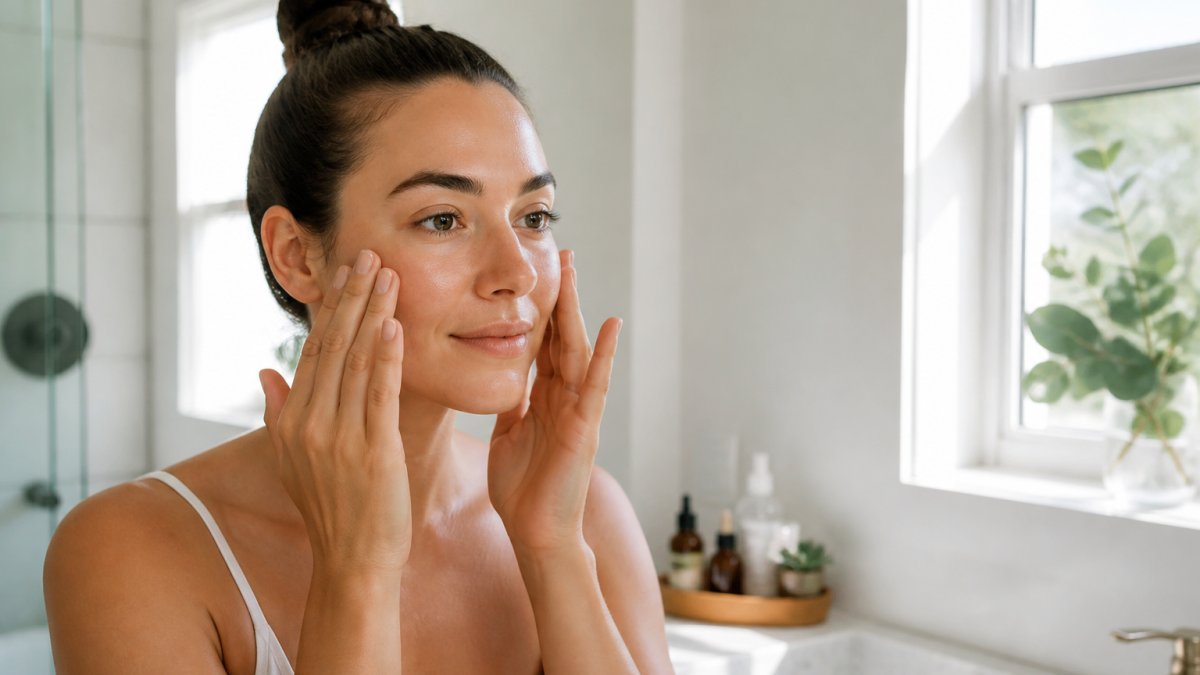
Consistency is non-negotiable: skipping applications delays visible results, while daily effort compounds.
Building Tolerance and Avoiding Irritation
Some firming serums contain actives that can irritate sensitive skin initially. Start slowly if you're new to potent formulas like retinol or high-concentration vitamin C.
Watch for these signs of irritation:
- Redness lasting more than 30 minutes after application
- Burning or stinging that doesn't fade quickly
- Increased dryness or flaking
If irritation occurs, reduce to 3 times per week, spaced 48 hours apart. Once skin adjusts, gradually increase frequency again.
Never combine multiple active serums while building tolerance. If you use vitamin C serum, wait at least 2 weeks before adding retinol or other potent actives.
Firming Serum Before and After: What Changes to Expect
Real results from firming serum show up gradually, knowing what to expect keeps you motivated.
Visible changes typically appear in this order:
Skin texture improves first, your face feels smoother and pores appear smaller, because hydration plumps skin cells.
Brightness comes next.
Fine lines appear softer around weeks 8 to 12.
PCA SKIN - ExLinea® Pro Peptide Serum (30 ml) - Available in Deluxe Travel Size →
Firmness and elasticity improve gradually over 12+ weeks, the deepest change, requiring sustained collagen support.
Be realistic: firming serum won't eliminate deep wrinkles or sagging skin, and won't replace professional treatments like microneedling or injectables.
Retinol vs Vitamin C for Wrinkles: Which Works Faster
Retinol and vitamin C both target wrinkles, but through different mechanisms and timelines.
Retinol works faster for wrinkles. Most people see visible improvement in fine lines within 8 to 12 weeks. Retinol increases cell turnover and stimulates collagen production directly.
The practical difference:
- Choose retinol if: You have resilient skin, want faster wrinkle reduction, and don't mind potential dryness or peeling during adjustment
- Choose vitamin C if: You have sensitive skin, want brightening plus wrinkle reduction, and prefer a gentler introduction to actives
Many people use both: vitamin C in the morning for antioxidant protection and brightening, retinol at night for wrinkle reduction. Introduce them separately, 2-3 weeks apart.
The products we carry at OC Skin Source reflect this balance. The PCA SKIN ExLinea Pro Peptide Serum targets expression lines from facial movement. The Marini SkinSolutions C-ESTA Face Serum combines lipid-soluble vitamin C with DMAE for wrinkle reduction and skin lifting.


Factors That Affect How Quickly Firming Serum Works
Your results depend on variables about you and about the bottle. The second group often matters more: a poorly formulated serum won't deliver results no matter how disciplined your routine.
Formulation Factors: Why Two "Vitamin C Serums" Aren't the Same Product
If you're using a vitamin C firming serum, the form of vitamin C changes how fast, and whether, you see results.
- L-ascorbic acid is the most studied form and the one most clinical research uses, but also the least stable. It oxidizes readily with light, heat, and oxygen, turning yellow to orange to brown. A browned serum isn't dangerous, but it's no longer doing the job you paid for.
- Derivatives such as sodium ascorbyl phosphate, magnesium ascorbyl phosphate, ascorbyl glucoside, and tetrahexyldecyl ascorbate are more stable and gentler, but must be converted by the skin into ascorbic acid before acting. That step means results typically take longer, often 12 weeks or more rather than 8.
- Concentration follows a curve, not a straight line. Most L-ascorbic acid research uses roughly 10% to 20%. Below that, effects are weaker; above roughly 20%, irritation risk rises faster than benefit. A 30% serum isn't "stronger" in any useful sense, just more irritating with no demonstrated extra payoff.
A practical test: if a serum has turned noticeably darker than when you bought it, or smells sharply of hot metal, it has oxidized and won't deliver the promised timeline.
Personal Factors: What You Bring to the Routine
These are the variables you can influence, and they interact with the formulation factors above.
- Skin type. Oily skin often shows surface changes faster because barrier function and hydration are already strong. Dry skin may need longer to build tolerance and absorb actives. Sensitive skin requires a slower ramp-up but reaches the same endpoint.
- Baseline condition. Early fine lines and mild unevenness respond faster, often within 4 to 6 weeks. Established wrinkles and significant sun damage need 12 weeks or more, and the realistic ceiling is "softer-looking," not "erased."
- Daily sunscreen use. The single largest lever you control. Without it, UV exposure generates new photodamage faster than a serum can offset existing damage. With it, the serum's antioxidant work is protected.
How to Tell Whether the Problem Is You or the Product
If results are slow, run through this before switching products:
- Is the serum still fresh? Check color and smell. Oxidized product is the most common and fixable cause of "it stopped working."
- Are you applying to dry skin? Water dilutes the formula and reduces how much active reaches the skin.
- Are you using it daily? If not, the timeline hasn't started.
- Are you wearing sunscreen every morning? If not, you're working against yourself.
- Have you given it a full 12 weeks? If yes to all of the above and still nothing, the formulation is the likely culprit, check form, concentration, pH, and packaging before buying another bottle of the same type.
Common Mistakes That Delay Firming Serum Results
Most people don't get expected results because of preventable mistakes. Avoid these:
Expecting overnight results. Firming serum works gradually, expect wrinkles to disappear in 2 weeks and you'll give up too early. Set realistic expectations: 4 to 12 weeks for visible changes.
Applying to wet skin. Water dilutes your serum and reduces how much active reaches your skin cells.
Skipping sunscreen. Sun exposure creates new wrinkles faster than your serum can reduce existing ones.
Switching products too frequently. Skin needs at least 8 weeks to respond to a new serum.
Using inconsistently. Skin responds to regular, daily exposure to actives; sporadic use extends your timeline significantly.
Conclusion: Setting Realistic Expectations
How long for firming serum to work depends on consistency and realistic expectations. Most people see visible improvements in texture and firmness within 6 to 12 weeks of daily use; deeper changes in wrinkle appearance and elasticity take 12+ weeks.
Results are cumulative: small weekly improvements add up over months as your skin repairs and rebuilds.
At OC Skin Source, we recommend starting with a product matched to your skin concerns. The HydroPeptide Power Serum combines multiple peptide complexes with collagen-supporting antioxidants.

| Timeline | Expected Results | Key Factors |
|---|---|---|
| Weeks 1-3 | Improved hydration, smoother texture | Skin adjusting to product |
| Weeks 4-6 | Visible smoothness, reduced pore appearance | Consistent daily use |
| Weeks 8-12 | Firmness improves, fine lines soften | Collagen support building |
| Weeks 12+ | Sustained elasticity, ongoing wrinkle reduction | Long-term commitment |
Frequently Asked Questions
How long does it take for a firming serum to work?
Most firming serums show initial results within 2-4 weeks of consistent daily use, though visible firmness improvements typically emerge between 6-12 weeks. Peptide-based serums like those with neuropeptide technology may deliver faster results because they target multiple aging pathways simultaneously. Full benefits, including improved skin elasticity and reduced fine lines, often require 12 weeks or longer of continuous use. Consistency matters more than the timeline itself, skipping applications delays results significantly.
How long does vitamin C serum take to show results?
Vitamin C serums typically show brightening effects within 2-4 weeks, though firming and collagen-supporting benefits take 8-12 weeks to become noticeable. Lipid-soluble vitamin C formulations like Ascorbyl Palmitate may work slightly faster than traditional L-ascorbic acid because they penetrate more efficiently with less irritation. Results depend on serum concentration, your skin type, and how well your skin barrier tolerates the ingredient. Daily sunscreen use amplifies results since vitamin C works best when protected from sun exposure.
Can a firming serum make skin look tighter right away?
Yes, some firming serums deliver immediate plumping effects that create a temporary tightness within minutes to hours due to hydration and light-reflective ingredients. However, this temporary tightness is different from actual structural firming. Real collagen production and skin elasticity improvements require 6-12 weeks of consistent use. If you're looking for instant visible lift, serums with hydrating ingredients and peptides that support skin structure offer the best combination of immediate and long-term benefits.
Is retinol or vitamin C better for wrinkles?
Retinol works faster for wrinkle reduction, typically showing results within 4-8 weeks, because it directly increases cell turnover and collagen production. Vitamin C takes 8-12 weeks but offers antioxidant protection and brightening alongside firming benefits. Many dermatologists recommend using both in a staggered routine, vitamin C in the morning for protection and brightening, retinol at night for wrinkle reduction. Start with one active ingredient and introduce the other gradually to avoid irritation, especially if you have sensitive skin.