
Why Esthetician Curated Skincare Products Work
Table of Contents
- Why Esthetician Curated Skincare Products Beat Trial and Error
- The Benefits of Medical Grade Skincare: Concentrations That Matter
- How to Build a Professional Skincare Routine That Actually Works
- Common Skincare Mistakes to Avoid When Self-Prescribing
- Clinical Results and the Financial ROI of Professional Products
- Post-Procedure Maintenance and Long-Term Skin Health
- Frequently Asked Questions
Last Updated: September 14, 2026
Why Esthetician Curated Skincare Products Beat Trial and Error
Esthetician curated skincare is the practice of having a licensed professional select products for your specific skin concerns instead of guessing your way through the aisle. At OC Skin Source, every formula is personally reviewed and chosen by licensed esthetician Sasha Young. That distinction matters because trial and error is expensive: the average adult cycles through multiple cleansers, serums, and moisturizers before landing on something that works, and each wrong pick can trigger irritation, clogged pores, or a stalled routine. Below, we break down why professional selection outperforms random experimentation, and how to build a regimen that respects your skin barrier.
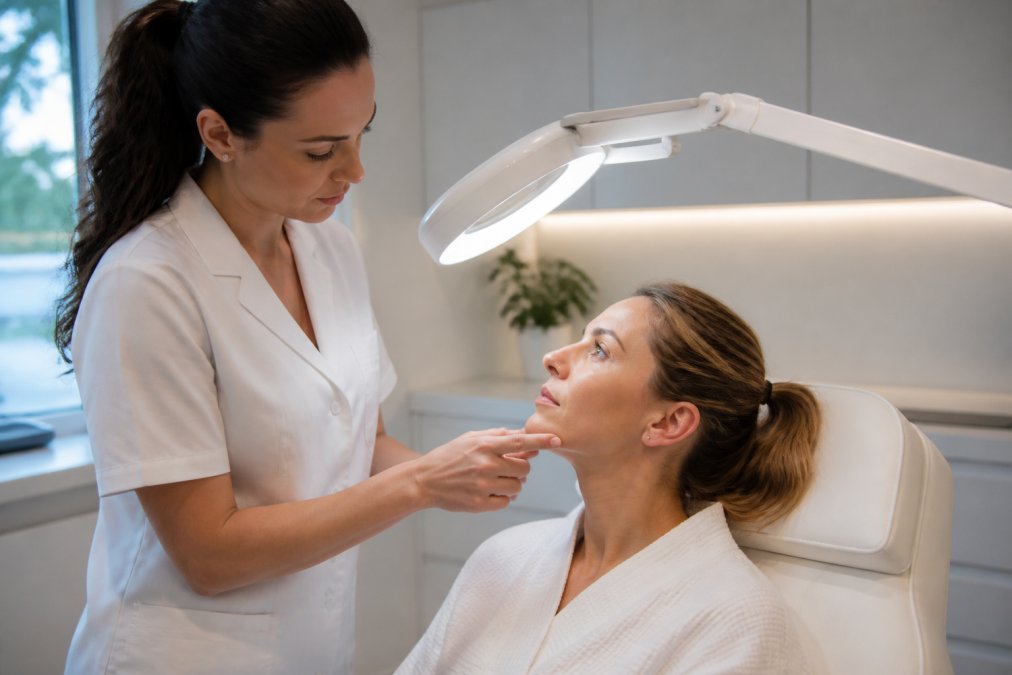
The core problem with self-prescribing is that skin concerns rarely announce themselves clearly. Redness might signal rosacea, a damaged barrier, or simple dehydration, and each calls for a different active ingredient at a different strength. A licensed esthetician reads those signals during a skin analysis, then matches product formulation to what your skin actually needs. That is the difference between buying a trend and buying a treatment.
The Benefits of Medical Grade Skincare: Concentrations That Matter
The benefits of medical grade skincare come down to concentration and delivery. Professional-grade formulas typically carry higher percentages of active ingredients than mass-market equivalents, and they are buffered so those concentrations remain stable and tolerable. A retinol serum sold at a drugstore may sit at a fraction of the strength a clinical-strength formula uses, which is why results plateau (pubmed.ncbi.nlm.nih.gov).
Concentration alone is not the goal. Bioavailability, how much of an ingredient actually reaches living skin, decides whether a product performs. Professional lines invest in transdermal delivery systems and formulation stability for exactly this reason. Higher concentration without delivery is just expensive liquid.
How Skin Barrier Function and pH Balance Affect Product Absorption
A compromised skin barrier absorbs everything unevenly, including irritants. The barrier is your acid mantle, a slightly acidic film that keeps moisture in and aggressors out (pubmed.ncbi.nlm.nih.gov). When pH balance drifts, cellular turnover slows, sensitivity climbs, and even well-formulated products sting.
This is why patch testing and a gradual introduction matter. A product that works beautifully on an intact barrier can inflame a damaged one. Restoring barrier function first, then layering actives, is the sequence professionals follow.
How to Build a Professional Skincare Routine That Actually Works
Building a professional skincare routine starts with assessment, not shopping. A licensed esthetician evaluates your skin type, concerns, and sensitivity, then sequences products so each one supports the next. The order below reflects standard clinical practice.
- Cleanse with a pH-appropriate cleanser
- Apply a targeted treatment serum while skin is damp
- Layer a moisturizer to seal hydration
- Finish with sun protection every morning
- Introduce one new active at a time, two weeks apart
- Reassess with a professional every few months
That last step is where most self-built routines collapse. Skin changes with seasons, hormones, and age, and a regimen that worked in your thirties may underperform in your fifties. A customized regimen is a moving target, not a fixed list.
The Science of Product Layering: Order, Timing, and Transdermal Delivery
Layering follows a simple rule: thinnest to thickest. Water-based serums go first, oils and occlusive moisturizers last, because heavier textures block lighter ones from penetrating. Wait roughly a minute between steps so each layer absorbs.
Timing matters as much as order. Retinoids belong at night because sunlight degrades them (pubmed.ncbi.nlm.nih.gov). Antioxidants like vitamin C work best in the morning under sun protection. Get the sequence and the clock right and transdermal delivery improves without changing a single product.
Common Skincare Mistakes to Avoid When Self-Prescribing
The most common skincare mistakes to avoid all share one root cause: treating symptoms without understanding the skin. Stacking multiple actives at once, skipping sun protection, and over-exfoliating are the three that send people back to square one.
- Mixing retinoids with strong acids on the same night, which overwhelms the barrier
- Exfoliating daily, which strips the microbiome and triggers rebound oil
- Skipping SPF, which undoes every brightening and anti-aging effort
- Chasing hyperpigmentation with harsh scrubs instead of targeted treatment
- Ignoring comedogenic ratings when choosing a moisturizer for acne-prone skin
Clinical Results and the Financial ROI of Professional Products
The "professional skincare is expensive" objection rarely survives a cost-per-result calculation. The comparison that matters is not bottle price versus bottle price, it is total spend over a defined period versus measurable outcome. Most people comparing a $60 serum to a $140 serum are not comparing equivalent products; they are comparing one product that may not be formulated to penetrate with one that is.
Run the math on a typical trial-and-error cycle. A common pattern is three to five cleansers, two to three serums, and two moisturizers over twelve to eighteen months before someone lands on a combination that works. At mass-market prices, that is often several hundred dollars spent, plus the cost of treating the irritation, clogged pores, or flare-ups that wrong picks cause. None of that spend produces a result, it produces information.
A curated regimen inverts the sequence. Assessment comes first, so the products selected are matched to skin type, concern, and sensitivity before money changes hands. Fewer products, each doing a defined job, replaced on a predictable schedule rather than abandoned mid-bottle. The relevant metric is cost per month of consistent use, not cost per unit.
What "Clinical Results" Actually Means on a Label
"Clinical" and "medical grade" are not regulated terms in the way most consumers assume. What backs a real efficacy claim is testing: instrumental measurement of hydration, TEWL, elasticity, or pigment intensity over a defined period, often 8 to 12 weeks, on a defined panel. Products with that data behind them tend to cost more because the testing does. When a brand can show you the study design, the panel size, and the measured endpoints, the price reflects formulation and verification rather than packaging.
That is the practical difference between shelf appeal and substantiated performance. A product can look premium, smell pleasant, and photograph well while containing actives at concentrations too low to do anything. Concentration, delivery system, and stability testing are what separate a treatment from a moisturizer with a nice label.
The Cost of Getting It Wrong
The hidden line item in self-prescribed routines is recovery. Over-exfoliation, stacked actives, and incompatible layering send people to a professional anyway, often after months of damage and sometimes after a course of prescription treatment. Add the replacement cost of every abandoned product and the "cheaper" drugstore route frequently costs more in the first year than a guided regimen does.
OC Skin Source's Personalized Virtual Skincare Consultation is $75, and the fee comes back as a product credit when you purchase $250 or more in recommended products. Framed against a single wrong $80 purchase, the consultation pays for itself before the first product ships.

Where the ROI Shows Up Over Time
Professional-grade routines tend to show their financial advantage in years two and three, not month one. Consistent use of a well-formulated retinoid, antioxidant, and sunscreen regimen reduces the need for corrective procedures later, the same logic that makes preventive dental care cheaper than restorative work. The people who spend least on skincare over a decade are rarely the ones who bought the least; they are the ones who bought correctly the first time and stayed consistent.
Kits like the HYDRINITY Restorative Kit and the HYDRINITY Age Renewal Kit pair hydration with renewal in a two-step format, which reduces the number of decisions and the number of half-used bottles in the cabinet. For a more comprehensive age-management approach, the OURSELF Collagen Reset Regimen layers firming and brightening actives in a three-step system.


Post-Procedure Maintenance and Long-Term Skin Health
Post-procedure maintenance is where professional guidance pays off most. After a peel, laser session, or microneedling treatment, the skin is temporarily more permeable and needs barrier support, hydration, and strict sun protection. The wrong product during this window can set recovery back weeks.
Long-term skin health leans on preventative care rather than correction. Consistent hydration, antioxidants, retinoids, and sun protection compound over years. So does neglect. The people who age well are rarely the ones who bought the most products; they are the ones who stayed consistent with a regimen built for their skin.
Kits like the HYDRINITY Restorative Kit and the HYDRINITY Age Renewal Kit pair hydration with renewal in a two-step format, which makes post-procedure and maintenance routines easier to keep up with. For a more comprehensive age-management approach, the OURSELF Collagen Reset Regimen layers firming and brightening actives in a three-step system.
Frequently Asked Questions
What is the difference between medical-grade and drugstore skincare?
Medical-grade skincare contains higher concentrations of active ingredients like retinoids, antioxidants, and exfoliating acids that are proven to change skin at a cellular level. Drugstore products often use lower concentrations because they are formulated for mass distribution and general safety. A licensed esthetician can help you understand which medical-grade formulations target your specific concerns, such as hyperpigmentation or fine lines, without causing irritation.
How does an esthetician determine which products are right for my skin?
A licensed esthetician begins with a thorough skin analysis, examining your skin barrier, hydration levels, and sensitivity. They consider your concerns, lifestyle, and any past reactions to ingredients. During a consultation, they may recommend patch testing and explain how product layering works with your skin's pH balance. This customized approach ensures you get a regimen that supports collagen production and cellular turnover without triggering flare-ups.
Are esthetician-curated products worth the higher price point?
Professional-grade products often cost more because they contain clinical-strength ingredients with proven bioavailability and formulation stability. Over time, this can save you money by reducing wasted purchases on ineffective products. Many estheticians offer virtual consultations that include product recommendations tailored to your skin, and some brands provide credits toward future purchases. The real value lies in getting a targeted treatment plan that delivers visible results.
What are the risks of using skincare products without professional guidance?
Without professional guidance, you risk irritation, compromised skin barrier, and worsening of conditions like rosacea or acne. Mixing incompatible active ingredients, such as certain retinoids and acids, can cause redness, peeling, and long-term sensitivity. A licensed esthetician helps you avoid these common mistakes by teaching you how to introduce products gradually and which combinations support your skin's microbiome and overall health.
Persistent skin concerns rarely resolve through more products; they resolve through the right ones. OC Skin Source takes the guesswork out of that search by curating medical-grade formulas personally selected by licensed esthetician Sasha Young, with education built into every recommendation. Get started with OC Skin Source and build a regimen that actually matches your skin.