
How to Check Skincare Expiration Dates Safely
Why Checking Skincare Expiration Dates Matters
Skincare expiration dates are the manufacturer's guidance on how long a product stays stable and safe to use.
A cream that worked beautifully in January can turn on your skin by summer.
Below, we cover where dates hide on packaging, how to read the symbols most people ignore, and how to judge a product when the label has worn off.
Step 1: Find the Printed Date on the Packaging
Start with the box, not the jar. Manufacturers usually print the full date on the outer carton, then stamp only a code on the container itself.
Check these spots in order:
- The bottom of the carton, often embossed rather than inked
- The crimp of a tube, where the plastic is sealed
- The base of a jar or bottle, sometimes under a sticker
- The back label, near the ingredients list
The printed date is often a manufacture date, not an expiration date. That distinction trips up almost everyone.
Manufacture Date vs. Expiration Date
A manufacture date tells you when the product was made; an expiration date tells you when it should no longer be used. Packaging rarely labels them clearly.
- Manufacture date: often written as MFG, PROD, or a plain date like 03/2026
- Expiration date: often written as EXP, or a date with a small hourglass icon
- No date at all: common on smaller containers, which is where the batch code comes in
If you only see one date and no label, assume it is the production date. Then apply the product's typical shelf life from there.
Step 2: Read the Open-Jar Symbol and PAO Number
The open-jar symbol, also called the Period After Opening (PAO) mark, is a small drawing of an open cosmetic jar with a number and the letter M inside it.
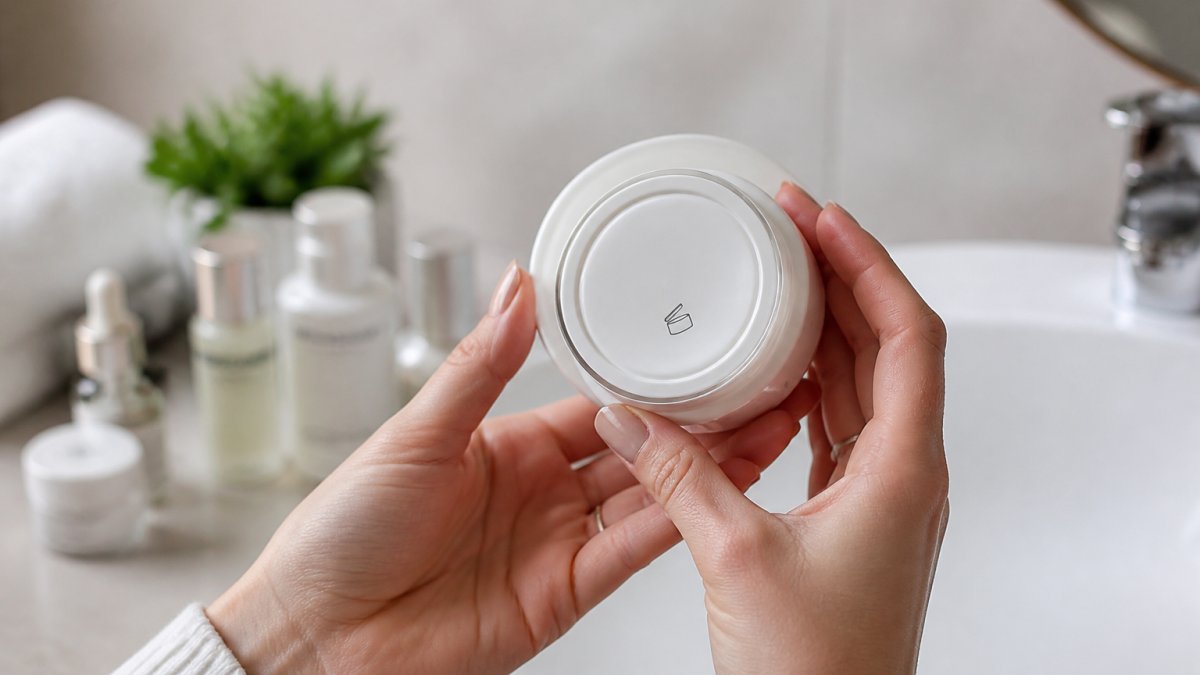
The M stands for months. A "12M" symbol means twelve months after opening. A "6M" means six.
A common mistake is reading the PAO as a shelf life from purchase. It is not. The clock starts the day you break the seal.
Step 3: Locate the Batch Code or Lot Number
A batch code, also called a lot number or lot code, is a short string of letters and numbers stamped on the product that identifies the production run and often encodes the manufacture date.
Where to look:
- Stamped into the base of the container
- Printed along the crimped edge of a tube
- Etched faintly on the back label
These codes are brand-specific, so a lookup tool can only estimate. If the code is illegible or missing, contact the manufacturer with the product name and where you bought it, the only way to get a confirmed date.
How to Use a Cosmetic Batch Code Checker
A cosmetic batch code checker is a website or app where you enter a brand name and batch code to get an estimated production date. It is a useful starting point, not a final answer.
What a Batch Code Actually Encodes
A batch code identifies the production run and often encodes the manufacture date, but the format is brand-specific, the same six-character code can mean different things across brands.
Most checkers match the brand and code pattern against a database of known formats, so the tool is only as good as its database. If the brand changed its coding system, moved production, or the code was misread, the estimate can be off by months, or return nothing.
A Safer Step-by-Step Process
- Find the batch code on the container itself, not the outer box. The box and the jar can carry different codes.
- Enter the brand exactly as printed, including capitalization and punctuation.
- Type the code with no spaces or dashes.
- Note the estimated production date it returns.
- Cross-check against any printed date on the packaging.
- If the tool returns no result or an implausible date, stop there and verify with the manufacturer.
Why the Result Is an Estimate, Not a Verdict
A batch-code tool estimates when a product was made. It cannot confirm how it was stored, whether the seal was intact, or whether the formula is still stable, two jars from the same batch can have very different shelf lives depending on heat, light, and humidity.
Treat the result as one data point. If the estimate and the printed date conflict, trust the printed date; if the estimate suggests the product is older, treat the earlier date as the safer assumption.
How to Verify an Uncertain Date with the Manufacturer
When the code is illegible, missing, or the checker returns nothing useful, contact the manufacturer with these details ready:
- The product name and size
- The batch or lot code, even if partial
- Where and when you bought it
Ask specifically for the manufacture date and the recommended expiration or period-after-opening guidance for that batch. A written response from the manufacturer is the only confirmation that does not depend on a third-party estimate.
When to Skip the Checker Entirely
Skip the tool and go straight to the manufacturer or the discard decision when:
- The product has no batch code at all
- The code is worn, smudged, or only partially readable
- The brand is not in the checker's database
A checker is a convenience, not a safety certification. The packaging, the manufacturer, and your own inspection are the reliable sources.
How Long Does Skincare Last After Opening?
How long skincare lasts after opening depends on the formula and the PAO mark, but most products fall into predictable ranges. Unopened, a sealed product can last well past its PAO.
| Product Type | Typical Unopened Shelf Life | Typical Use After Opening |
|---|---|---|
| Facial cream in a jar | 2-3 years | 6-12 months |
| Serum with vitamin C | 1-2 years | 3-6 months |
| Retinol products | 2 years | 6 months |
| Cleanser | 2-3 years | 12 months |
| Sunscreen | Per printed expiration | One season of use |
| Perfume | 3-5 years | 1-2 years |
These are general ranges. Always defer to the PAO on your specific product. A jar formula exposed to air and fingers daily will degrade faster than an airtight pump.
Signs Skincare Has Expired: What to Look, Smell, and Feel For
Signs skincare has expired show up in how it looks, how it smells, and how it feels on your skin. Trust your senses over the label when they disagree.
Look for:
- Separation, where liquid and cream split
- A color shift, especially browning in vitamin C serums
- Cloudiness in a product that was clear
Smell for:
- A sour or rancid note
- A sharp chemical smell that was not there before
- Any scent that makes you pull back
Feel for:
- A gritty or grainy texture in a cream
- A formula that no longer spreads smoothly
- Stinging or burning that the product never caused before
If any of these appear, stop using it, even if the date says otherwise.
When Dates Are Missing or Conflict
Sometimes there is no date, the code is worn off, and the PAO has faded. Here is how to decide:
- Date missing, product looks and smells normal: use with caution, and finish it within a few months
- PAO passed but product is unopened: the printed expiration still governs
- Printed date and PAO conflict: the earlier of the two wins
When in doubt, throw it out. A replacement costs far less than a damaged skin barrier.
How to Store Skincare Products to Extend Shelf Life
How you store skincare products changes how long they last. Heat, light, air, and moisture are the four enemies, and most bathrooms deliver all four, and storage is where contamination starts.
The Four Factors That Break Down Formulas
- Heat: accelerates the breakdown of preservatives and actives. A bathroom that steams up daily is a heat chamber.
- Light: ultraviolet and visible light can degrade vitamin C, retinol, and some sunscreen filters.
- Air: oxygen drives oxidation, which is what turns a vitamin C serum brown and a face oil rancid.
Where to Store Products
- Keep products out of direct sunlight, in a cabinet or drawer.
- Avoid the shower shelf, where steam and heat speed breakdown.
- Close lids tightly after every use.
Contamination Prevention
Contamination is the quiet cause of many reactions blamed on expiration. A product can be within its PAO and still be contaminated if handled poorly.
- Wash hands before applying anything from a jar.
- Use a clean spatula or spoon for creams and balms.
- Do not share products that touch the skin directly, especially eye products and anything applied with fingers.
Product-Specific Storage Notes
- Vitamin C serums: light and air are the main enemies. An opaque, airless pump stored in a dark drawer lasts longer than a dropper bottle on a sunny shelf.
- Retinol: degrade with light and heat. Keep the cap tight and store away from windows.
- Sunscreen: active filters can degrade with heat and light. A tube left in a hot car may no longer protect as labeled, even if the printed date has not passed. If the texture or scent has changed, replace it.
When Storage Has Failed: Safe Disposal
If a product has separated, changed color, smells off, or passed its earlier date, dispose of it responsibly rather than using it up.
- Do not flush liquids or creams down the drain in large amounts; check local household hazardous waste guidance for products with actives.
- Empty containers can usually be recycled according to the package label.
- Keep products out of reach of children and pets before disposal.
At OC Skin Source, every product we carry is selected with stability in mind.
Frequently Asked Questions
How do I check if my skincare is expired?
Start by looking for a printed expiration date on the carton or the bottom of the packaging. If there is none, find the Period After Opening symbol, a small open-jar icon with a number and the letter M inside, which tells you how many months the product stays usable after you first open it. You can also enter the batch code into a cosmetic batch code checker for an estimate. If the texture, smell, or color has changed, discard it even if the dates suggest it is still fine.
Can I use 2-year-old skincare?
It depends on the product and how it was stored. Unopened products typically last two to three years from the manufacture date, so a two-year-old sealed product may still be usable if the packaging shows no damage and the formula looks and smells normal. Once opened, most skincare lasts six to twelve months, so a two-year-old opened jar should be discarded. Sunscreens and products with active ingredients like vitamin C degrade faster and should be replaced sooner.
What does the open-jar symbol on skincare packaging mean?
The open-jar symbol, also called the Period After Opening mark, shows how many months a product stays usable after you first open it. The number inside the jar, followed by the letter M, is the count of months. A 6M mark means six months after opening, a 12M mark means twelve months. This clock starts the day you break the seal, not the day you bought the product, so write the open date on the label to keep track.
How should I store skincare products to help them last longer?
Keep products away from heat, direct sunlight, and steamy bathrooms, since heat and moisture break down formulas and encourage bacteria. Store them in a cool, dry cabinet or drawer with the lids tightly closed. Use clean hands or a spatula to scoop creams from jars, and avoid sharing products. Sunscreens and vitamin C serums benefit most from cool storage. If a product changes color or smell before its date, storage conditions are often the cause.
Checking dates takes a few minutes, but the payoff is skin that stays calm and products that actually perform. If you are tired of guessing which formulas are still good and which should go, OC Skin Source takes the work out of it. Every item is personally reviewed by licensed esthetician Sasha Young, so you get professional-grade options matched to your skin concerns. Browse our curated brands and build a routine you can trust from the first use to the last. View all brands →