
How to Build a Skincare Regimen: Step-by-Step Guide
Table of Contents
- How to Identify Skin Type Before Building a Skincare Regimen
- Skincare Routine for Beginners: The Four Core Steps
- Skincare Routine Order: Why Sequence Determines Results
- When to Use Active Ingredients (and What to Never Mix)
- Morning vs. Evening: Two Versions of the Same Regimen
- Budget vs. Luxury Layering: Where to Spend and Where to Save
- Frequently Asked Questions
Last Updated: September 18, 2026
How to Identify Skin Type Before Building a Skincare Regimen
Most people guess their skin type once, years ago, and never revisit that answer when building a skincare regimen. That guess then shapes every product they buy. This guide from OC Skin Source starts somewhere more reliable: what your skin actually does when you leave it alone.
The Bare-Face Test: What Your Skin Does After Cleansing
Wash with a gentle cleanser, pat dry, and apply nothing for 30 minutes. Then look.
- Tight and flaky everywhere: dry skin, often with a compromised lipid barrier
- Shiny across the forehead, nose, and chin: oily skin
- Shiny in the T-zone only: combination skin
- Red, stinging, or reactive: sensitive skin, which overlaps with every other type
- Comfortable and even: balanced skin, which still needs maintenance
Matching Concerns to Product Categories
Skin type tells you what to avoid. Concerns tell you what to treat. Acne-prone skin points toward salicylic acid and non-comedogenic formulas. Hyperpigmentation points toward vitamin C and consistent sun protection. Fine lines point toward retinoids and peptides. Rosacea and reactivity point toward barrier support first, actives later.

Skincare Routine for Beginners: The Four Core Steps
The best beginner routine has four steps, done consistently, in this order: cleanse, treat, moisturize, protect. Nothing else is required to see improvement. Most people who feel their routine "isn't working" are missing consistency on one of these four, not missing a fifth product.
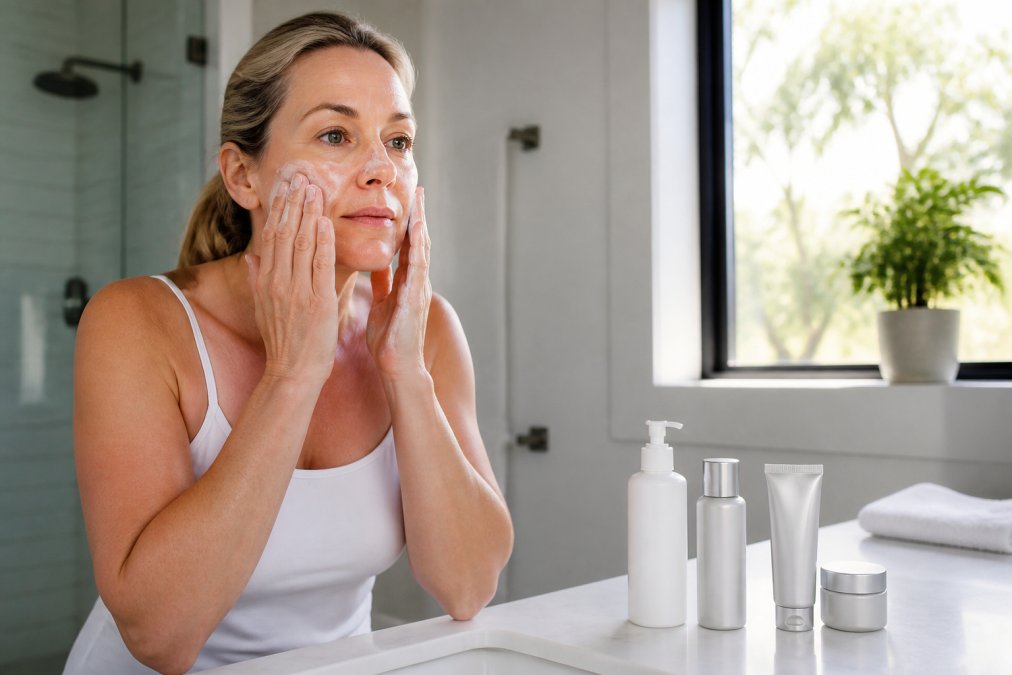
Step 1: Cleansing Without Stripping the Skin Barrier
A cleanser's job is removal, not squeaky-clean tightness. That tight feeling means you've stripped the acid mantle, the slightly acidic film (around pH 4.5 to 5.5) that keeps the microbiome balanced and holds moisture in (Importance of Stratum Corneum Acidification to Restore Skin Barrier Function in...). When the barrier is compromised, water evaporates faster and irritants penetrate more easily, which is why over-cleansing often shows up as redness and flaking rather than "clean" skin.
Match the formula to your skin type:
- Dry or reactive: cream or milky cleanser, no foaming surfactants
- Oily or acne-prone: gel or foaming cleanser with salicylic acid if tolerated
- Combination: gel cleanser in the T-zone, gentler application on cheeks
- Sensitive: fragrance-free, minimal-ingredient formulas
Step 2: Treat, Step 3: Moisturize, Step 4: Protect
Treat means one targeted product, not five. Pick the active that matches your top concern: a retinoid for fine lines and texture, vitamin C for dullness and pigmentation, salicylic acid for clogged pores. Start at the lowest concentration, twice a week, and add frequency before you add strength. Most practitioners find that a single active used consistently for 8 to 12 weeks outperforms three actives rotated randomly.
How Long to Wait Between Steps
You don't need to wait long, but you do need to wait a little. Thirty to sixty seconds between layers is enough for most products to absorb. The exceptions:
- After retinoids: wait 5 to 10 minutes before moisturizer if you're prone to irritation
- After vitamin C: wait 1 to 2 minutes before the next layer to let it set
- Before sunscreen: let the layer beneath dry fully, or the SPF will pill and lose coverage
Skincare Routine Order: Why Sequence Determines Results
Skincare routine order is determined by texture and molecular size: thinnest first, thickest last. Get the sequence wrong and your most expensive product sits on top of a barrier it can't cross.
Thin to Thick: The Layering Rule That Prevents Pilling
Work from watery to creamy:
- Cleanser
- Toner or essence, if you use one
- Water-based serums with humectants
- Treatment serums with active ingredients
- Eye cream
- Moisturizer
- Sunscreen in the morning, facial oil at night
Wait 30 to 60 seconds between layers. Pilling, those little rolled-up balls of product, usually means you layered too fast or put an occlusive under a water-based serum.
Personalized Virtual Skincare →
When to Use Active Ingredients (and What to Never Mix)
Start one active at a time, at the lowest concentration, twice a week. Add frequency before you add strength. This rule exists because irritation from actives is cumulative, two mild actives used together can create a reaction neither would cause alone.
- Retinoids: evening only, pea-sized amount, expect a purge period of 2 to 6 weeks
- Vitamin C: morning, under sunscreen, where it boosts protection against free radicals
- Salicylic acid: acne-prone skin, oil-soluble, works inside the pore
- Glycolic acid: exfoliation and texture, but it increases sun sensitivity
- Niacinamide: pairs with almost everything, calms redness and regulates oil
- Ceramides: barrier repair, safe daily, ideal alongside any active
- Azelaic acid: redness, rosacea, and post-acne marks; gentler than most acids
- Benzoyl peroxide: inflammatory acne; effective but drying and incompatible with several actives
Interaction Warnings: Retinoids, Acids, and Vitamin C
Some pairings cause irritation or cancel each other out. The table below explains not just what to avoid, but why, because understanding the mechanism lets you decide when a pairing is worth the risk.
| Combination | Why It's a Problem | Do This Instead |
|---|---|---|
| Retinoid + glycolic acid | Both accelerate cell turnover; together they overwhelm the barrier's repair capacity | Alternate nights |
| Vitamin C + benzoyl peroxide | Benzoyl peroxide oxidizes vitamin C, rendering it ineffective | Use vitamin C in the morning, benzoyl peroxide at night |
| Retinoid + salicylic acid | Over-exfoliates, strips lipids, triggers sensitivity | Split across evenings |
| Two exfoliating acids | Doubles cellular turnover stress without added benefit | Pick one, twice weekly |
| Retinoid + vitamin C (same layer) | Different pH requirements; vitamin C needs acidic pH, retinoids work near neutral | Vitamin C in the morning, retinoid at night |
| Niacinamide + strong acids | Can cause flushing in sensitive skin at high concentrations | Separate by 30 minutes or use lower concentrations |
Age-Based Active Selection: What Changes and When
Most guides treat actives as one-size-fits-all. They aren't. What your skin needs at 25 is not what it needs at 50, and using the wrong active for your decade is one of the most common reasons a routine stalls.
- 20s: prevention and consistency. Sunscreen daily, a gentle cleanser, and one antioxidant. Retinoids are optional but reasonable if acne or texture is a concern. Avoid stacking acids.
- 30s: early fine lines and uneven tone appear. This is when a retinoid earns its place, paired with vitamin C in the morning. Add niacinamide if redness or oiliness persists.
- 40s: collagen loss accelerates and skin gets drier. Retinoids remain central, but barrier support becomes non-negotiable, ceramides, peptides, and richer moisturizers. Consider adding azelaic acid for hormonal pigmentation.
- 50+: thinning skin, deeper lines, and increased dryness. Lower retinoid frequency if irritation flares, lean harder on peptides and occlusives, and prioritize sunscreen and barrier repair over aggressive exfoliation.
Ingredient Transparency and Sustainability: What to Check Before You Buy
Most routines fail not because the actives are wrong, but because the formulas are unstable or the sourcing is opaque. Two things worth checking before you commit to a product:
- Packaging that protects the formula. Vitamin C and retinoids degrade with light and air. Opaque, airless pumps preserve potency better than jars or clear droppers.
- Ingredient sourcing and concentration. A "vitamin C serum" can contain 5% or 20%, the label rarely tells you. Look for brands that disclose concentration and form (L-ascorbic acid vs. derivatives behave differently).
- Refill and recycling programs. A growing number of brands offer refillable packaging, which cuts plastic waste without changing the formula you rely on.
Morning vs. Evening: Two Versions of the Same Regimen
Your morning routine is defensive. Your nighttime routine is reparative. That distinction decides what goes where.
Budget vs. Luxury Layering: Where to Spend and Where to Save
- Save on cleanser: it's on your face for under a minute. A quality gel cleanser at $58 does the job without a luxury markup.
- Spend on sunscreen: texture and finish determine whether you'll actually wear it daily. A mineral SPF 50 at $55 you enjoy using beats a cheap one that sits in a drawer.
- Spend on treatment: this is where active ingredients and formulation technology earn their price. A daily vitamin C moisturizer at $150 is doing antioxidant, collagen-support, and hydration work in one step.
- Save on toner: optional for most people, and rarely the difference-maker.
If product confusion is the real obstacle, a Personalized Virtual Skincare Consultation with a licensed esthetician replaces guesswork with a routine built around your skin type, concerns, and current products. At $75, with the fee credited back toward $250 in recommended products, it costs less than most failed product experiments.


Frequently Asked Questions
What is the 4-2-4 rule in skincare?
The 4-2-4 rule is a simplified timing framework: cleanse for 4 minutes total if you double cleanse (2 minutes oil-based, 2 minutes water-based), treat for 2 minutes to let actives absorb, and wait 4 minutes before applying sunscreen or makeup. It prevents pilling and gives each product time to work. Most people rush through a skincare regimen in 90 seconds, which reduces how well serums and moisturizers absorb.
Which two serums cannot be used together?
Retinoids and strong acids (glycolic, salicylic, lactic) should not be layered in the same session. Both accelerate cellular turnover, and combining them raises the risk of redness, peeling, and barrier damage. Vitamin C and benzoyl peroxide also conflict because benzoyl peroxide oxidizes vitamin C, making it ineffective. Alternate nights instead: retinoid one evening, exfoliating acid the next, and always follow with a ceramide-rich moisturizer.
How long does it take to see results from a new skincare regimen?
Hydration and skin texture improvements show up in 1 to 2 weeks. Hyperpigmentation and fine lines take 8 to 12 weeks because cellular turnover runs on a roughly 28-day cycle that slows with age. Retinoids typically need 12 weeks for visible collagen production changes. Take a baseline photo in consistent lighting on day one, then compare at weeks 4, 8, and 12 rather than judging results daily.
How do I determine my skin type if I have both oily and dry areas?
Combination skin is the most common type and means your T-zone (forehead, nose, chin) produces more oil while cheeks stay normal or dry. Wash with a gentle cleanser, wait 30 minutes without applying anything, then press a blotting sheet across your face. Oil on the T-zone only confirms combination skin. For a combination skin regimen, use a gel cleanser, a lightweight moisturizer everywhere, and spot-treat oily areas with niacinamide.