
Cystic Acne Products: How They Work
Table of Contents
- Understanding Cystic Acne and Why Standard Products Fall Short
- How Benzoyl Peroxide Works for Cystic Acne
- Salicylic Acid for Cystic Acne: Penetration and Pore Clearing
- Retinoids and Cell Turnover: Addressing Deep Inflammation
- Building Your Cystic Acne Skincare Routine: Product Combination and Layering
- How Long Acne Treatments Take to Work: Realistic Timelines and Measurable Progress
- Managing Side Effects and Knowing When to Escalate Treatment
- Frequently Asked Questions
Last Updated: October 9, 2026
Understanding Cystic Acne and Why Standard Products Fall Short
Standard acne products often fail because they work on the surface, while cystic acne forms when bacteria, dead skin cells, and excess oil get trapped far below where typical treatments reach.
At OC Skin Source, we focus on education over trends, explaining exactly how cystic acne products work so you can make confident choices.
Cystic acne requires ingredients that penetrate deeper and address inflammation at its source.
How Benzoyl Peroxide Works for Cystic Acne
Benzoyl peroxide is one of the few ingredients proven to reach deep into pores, killing acne-causing bacteria and releasing oxygen that creates an environment hostile to the bacteria in clogged pores.
Start low and build up. A 2.5% strength suits beginners and sensitive skin; the FACE REALITY 2.5% Advanced Acne Med uses micronized benzoyl peroxide, which penetrates more effectively than standard formulations with less dryness.

Jumping to the highest strength immediately causes irritation, redness, and peeling that worsens cystic acne.
Here's what to expect:
- Week 1-2: Mild dryness and slight redness
- Week 3-4: Reduced redness as bacteria die
- Week 6-8: Visible improvement in active breakouts
Use it once daily at first, at night, on clean, completely dry skin. Wait a few minutes before adding other products, since it can reduce the effectiveness of some ingredients if layered immediately.
Salicylic Acid for Cystic Acne: Penetration and Pore Clearing
For cystic acne, it prevents new lesions by keeping pores clear and reducing the buildup that leads to deep inflammation.
The standard concentration is 2%, which penetrates the pore lining effectively. The PCA SKIN Acne Gel uses an advanced delivery system to reach deeper into congested pores, with many users reporting visible improvement within three days.

It's gentler than benzoyl peroxide for many people but still requires gradual introduction: start 2-3 times per week and increase as your skin adapts.
Key differences between these two ingredients:
| Ingredient | Main Action | Best For | Typical Strength |
|---|---|---|---|
| Benzoyl Peroxide | Kills bacteria, releases oxygen | Active inflammation | 2.5-5% |
| Salicylic Acid | Dissolves oil and dead skin | Preventing new breakouts | 2% |
Salicylic acid works best on skin that isn't already irritated. With active inflammation, start with benzoyl peroxide, then add salicylic acid once it calms.
Retinoids and Cell Turnover: Addressing Deep Inflammation
Retinoids are the most powerful anti-acne ingredient for long-term improvement.
Retinoids also reduce inflammation at a cellular level and strengthen the skin barrier, meaning fewer deep, painful breakouts over time.
Pure retinol is the most accessible retinoid for home use. The PCA SKIN Intensive Clarity Treatment combines 0.5% pure retinol with 2% salicylic acid, addressing current breakouts and preventing future ones by improving turnover and clearing congestion simultaneously.
Retinoids require patience, results take 6-8 weeks, but cystic acne becomes less frequent and less severe.
Starting retinoids means managing the adjustment period carefully:
- Begin with the lowest strength available
- Use just 2-3 times per week initially
- Apply only a pea-sized amount to clean, dry skin
The "retinol uglies", temporary worsening during adjustment, are real: skin renews faster, bringing congestion to the surface.
Building Your Cystic Acne Skincare Routine: Product Combination and Layering
The biggest mistake is using too many actives at once. Combining benzoyl peroxide, salicylic acid, and retinoids simultaneously damages the skin barrier and causes severe irritation.
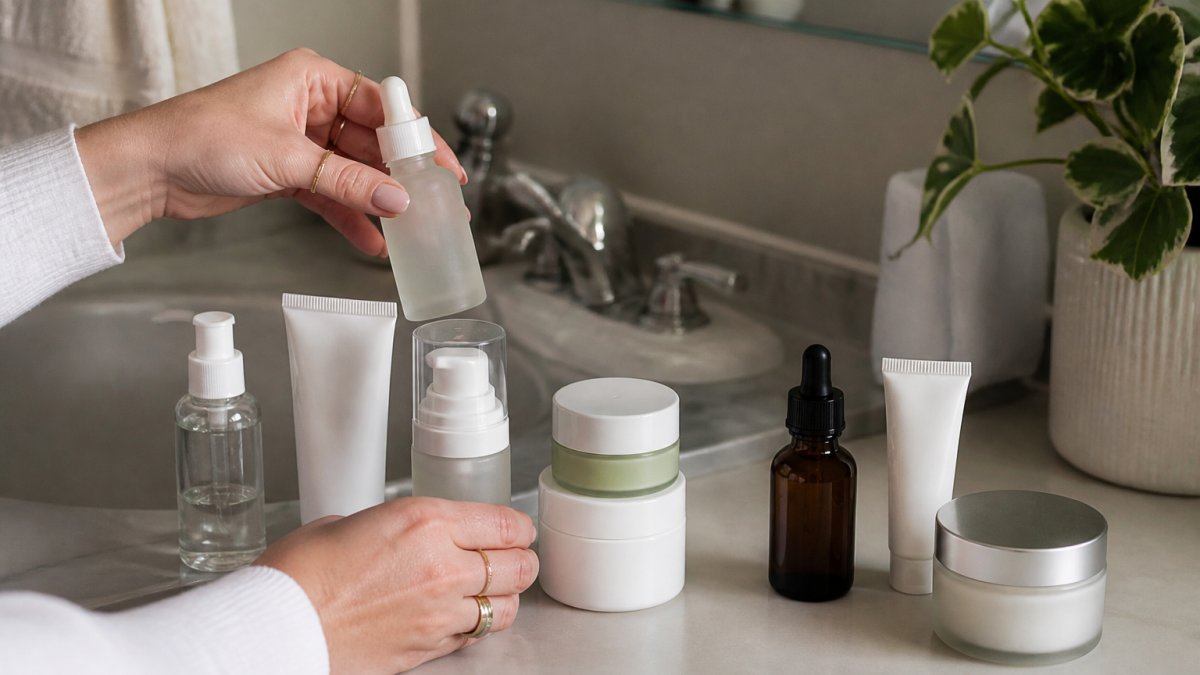
The rule that prevents most irritation: one new active at a time
Introduce one new active, then wait two to four weeks before adding the next. If irritation flares, you know which product caused it.
A morning-and-evening schedule you can actually follow
Morning (every day)
- Gentle, non-foaming cleanser, lukewarm water, 30 seconds, no scrubbing
- Lightweight moisturizer on damp skin
- Sunscreen, SPF 30 or higher, every day including cloudy days
Morning is deliberately boring: benzoyl peroxide, salicylic acid, and retinoids all increase photosensitivity, and layering them under sunscreen multiplies irritation. Save actives for night.
Evening (rotate actives by night)
- Gentle cleanser
- Wait until skin is completely dry, damp skin increases penetration and irritation
- One active only (see rotation below)
- Wait 10-15 minutes
- Moisturizer
The rotation, phase by phase
Phase 1 (Weeks 1-4): Foundation
- Benzoyl peroxide 2.5% at night, every night if tolerated
- Moisturizer and sunscreen daily
- No other actives
Phase 2 (Weeks 5-8): Add salicylic acid
- Alternate nights: benzoyl peroxide one night, salicylic acid 2% the next
- Never layer both on the same night, the combination strips the barrier faster than either alone
- Keep moisturizer and sunscreen unchanged
Phase 3 (Weeks 9+): Introduce a retinoid
- Retinoid 1-2 nights per week to start
- Benzoyl peroxide down to 1-2 nights per week
- Salicylic acid 2-3 nights per week
Overlapping irritants to avoid
These are the combinations that most often send people backward:
- Benzoyl peroxide + salicylic acid on the same night, doubles the drying effect with no added antibacterial benefit
- Retinoid + salicylic acid on the same night, both accelerate turnover; together they cause peeling and barrier damage
- Any active + physical scrub or exfoliating brush, mechanical exfoliation on top of chemical exfoliation is the fastest route to raw, inflamed skin
Layering order when you do use more than one product
Apply from thinnest to thickest consistency:
FACE REALITY - 2.5% Advanced Acne Med (1.5 oz - 44 ml) →
- Cleanser
- Water-based treatments (serums, gels)
- The night's single active
- Moisturizer
- Sunscreen (morning only)
Wait 10-15 minutes between the active and the moisturizer. This lets the active absorb and reduces the chance of pilling or dilution.
Patch testing before you commit
Before adding any new active to your full routine, apply a small amount to a quarter-sized area along the jawline or behind the ear for three consecutive nights. If that area stays calm, introduce it to the full face.
OC Skin Source carries medical-grade products formulated for this layering. The FACE REALITY 5% Advanced Acne Med and PCA SKIN Intensive Clarity Treatment work together in a structured routine, with soothing ingredients like bisabolol and plant stem cell extracts that minimize irritation.

How Long Acne Treatments Take to Work: Realistic Timelines and Measurable Progress
This is where most people quit too early. Cystic acne treatments don't work overnight; realistic timelines help you stay committed.
Benzoyl peroxide timeline:
- Week 2-3: Reduced bacterial count (not visible yet)
- Week 4-6: Redness decreases, active lesions flatten
- Week 8-12: New breakouts become less frequent
Salicylic acid timeline:
- Week 1-2: Pores appear cleaner
- Week 3-4: Reduced congestion and oil buildup
- Week 6-8: Fewer new breakouts forming
Retinoid timeline:
- Week 2-4: Skin adjustment (possible temporary worsening)
- Week 6-8: Cell turnover visibly improves
- Week 12+: Significant reduction in breakout frequency
The reason: cystic acne forms deep in the skin, and ingredients need time to reach that depth, kill bacteria, reduce inflammation, and let skin heal.
How to actually measure progress (not just "does it look better?")
Feelings are unreliable week to week. Track these instead:
- Lesion count, count new cysts each week and write the number down. A drop from six new cysts to four is progress even if your skin still looks angry.
- Pain and tenderness, cystic lesions hurt. When they stop hurting before they stop appearing, the anti-inflammatory effect is working.
- Time to heal, note how many days an individual cyst takes to flatten. Shortening that window is a real sign of improvement.
Take a weekly photo in the same lighting; side-by-side shots catch slow changes your mirror misses.
When to assess a product
Give each active a full 8 to 12 weeks before judging it. That window covers the adjustment phase, the drop in bacteria counts, and the first cycle of improved cell turnover.
At the 12-week mark, ask three questions:
- Are there fewer new cysts than when I started?
- Are the cysts I do get less painful and shorter-lived?
- Has my skin tolerated the routine without constant irritation?
If the answer to all three is yes, keep going. If the answer to all three is no, the product or the strength isn't the right fit.
Measurable signs of progress, in the order they usually appear
- Reduced pain and tenderness (week 2-3)
- Flattening of existing lesions (week 4-6)
- Fewer new breakouts (week 6-8)
When to stop experimenting and see a clinician
Over-the-counter products have a ceiling. Cystic acne still producing deep nodules after 12 weeks of consistent, correctly layered use generally needs clinician-directed treatment, not another product swap.
Escalate if any of these apply:
- No improvement after 12 weeks of consistent use
- New cysts are still forming at the same rate or faster
- Cystic acne covers large areas of the face, chest, or back
A dermatologist can prescribe stronger topical retinoids, oral antibiotics, hormonal treatments, or isotretinoin, and offer in-office options like cortisone injections to flatten existing cysts. Choosing that route isn't failure, deep, recurring cystic acne often sits beyond what a cleanser-and-serum routine can resolve.
Don't stack a new over-the-counter product on top of a failing one to "speed things up." Adding a second active mid-course is the most common reason people can't tell what's working and end up with a damaged barrier on top of unchanged acne.
Managing Side Effects and Knowing When to Escalate Treatment
Irritation is common when treating cystic acne. The key is distinguishing normal adjustment from actual damage.
Normal side effects (expected and temporary):
- Mild dryness and flaking
- Slight redness
- Temporary increase in breakouts (week 2-4)
Warning signs (stop and reassess):
- Severe burning or stinging that doesn't fade
- Hives or allergic reactions
- Persistent raw or bleeding skin
If warning signs appear, stop the active immediately, your barrier is compromised.
Many people benefit from prescription treatments when over-the-counter options plateau.
When to see a dermatologist:
- Cystic acne covers large areas of your face or body
- Over-the-counter treatments show no improvement after 12 weeks
- Breakouts are causing significant pain or scarring
Treating cystic acne products effectively means understanding how each ingredient works and giving treatments time.
OC Skin Source carries the medical-grade products that make this approach work.
Frequently Asked Questions
Can over-the-counter cystic acne products actually work, or do I need a prescription?
Over-the-counter products can help, especially for mild to moderate cystic acne, but deep cystic lesions often require prescription-strength treatment or professional intervention. Products like benzoyl peroxide and salicylic acid address bacterial growth and pore unclogging, but severe cystic acne, characterized by painful, deep nodules, may need oral antibiotics or hormonal treatments that only a dermatologist can prescribe. Start with professional-grade OTC options; if you see no improvement after 8-12 weeks, consult a dermatologist.
How long does it take for benzoyl peroxide to work on cystic acne?
Benzoyl peroxide typically begins reducing bacteria within days, but visible improvement in cystic lesions usually takes 4-8 weeks of consistent use. Smaller breakouts may clear faster, but deep cystic nodules require longer because the inflammation extends beneath the skin's surface. Many people see initial redness reduction within 2-3 weeks. Consistency matters: missing applications or switching products frequently delays results. The Face Reality 2.5% Advanced Acne Med is designed for those beginning benzoyl peroxide therapy, making it easier to build tolerance while your skin adjusts.
What's the difference between salicylic acid and benzoyl peroxide for treating cystic acne?
Benzoyl peroxide kills acne-causing bacteria and works on the surface and in pores, making it ideal for reducing active inflammation. Salicylic acid exfoliates inside pores, dissolving excess oil and dead skin cells to prevent clogs from forming. For cystic acne, combining both is often more effective than using one alone. Salicylic acid addresses congestion and cell turnover, while benzoyl peroxide tackles bacterial overgrowth. Products like PCA SKIN Intensive Clarity Treatment pair 2% salicylic acid with retinol to address multiple causes simultaneously.
Will introducing new cystic acne products irritate my sensitive skin?
New acne products can cause temporary irritation, especially if you have sensitive skin. Start slowly: introduce one product at a time, use it 2-3 times per week for the first week, then gradually increase frequency. Begin with lower-strength options like the 2.5% benzoyl peroxide formulation before advancing to 5%. Always patch-test on a small area first. If redness, burning, or peeling becomes severe, reduce frequency or stop and consult a dermatologist. Pairing acne treatments with a gentle moisturizer helps maintain your skin barrier and reduces irritation.