
Best Skincare Routine for Aging Skin: 7 Steps That Work
Table of Contents
- Why Aging Skin Needs a Different Skincare Routine
- The 7-Step Routine at a Glance
- Skincare Routine Order: What Goes On First and Last
- Step 1: Gentle Cleansing That Protects the Skin Barrier
- Step 2: Antioxidants and Vitamin C Serum in the Morning
- Step 3: Retinoids at Night for Cell Turnover and Collagen
- Step 4: Anti-Aging Skincare Ingredients That Actually Change Skin
- Step 5: Treating Fine Lines, Deep Wrinkles, and Hyperpigmentation
- Two Angles Most Guides Skip
- Matching Products to Your Main Concern
- Frequently Asked Questions
Last Updated: September 23, 2026
Why Aging Skin Needs a Different Skincare Routine
Aging skin loses collagen, elastin, and moisture year over year, so the best skincare routine for aging skin has to do more than cleanse and moisturize. It has to rebuild barrier function, support cell turnover, and defend against the UV damage that drives most visible aging.
This guide from OC Skin Source breaks the process into seven steps you can follow tonight.
The skin you had at 25 is not the skin you have at 45. Collagen production slows, natural lipids thin out, and the barrier that once held moisture in place starts letting it escape. According to the American Academy of Dermatology on aging skin, sun exposure accounts for the majority of visible skin aging, which means most of what you see in the mirror is cumulative UV damage rather than simple birthday math.
That distinction matters because it changes what you should buy. A rich cream can mask dryness for a few hours. It cannot replace the structural support that collagen and elastin provide. The routines that work long term are the ones that address barrier repair, cell turnover, and sun protection together.
Below, we will show you exactly how to build that routine in seven steps, in the right order, without wasting money on products that overlap.
The 7-Step Routine at a Glance
The best anti-aging routines follow a consistent order: cleanse, treat, hydrate, protect. Here is the full sequence so you can see how each step connects before we break them down.
| Step | Product Type | When | Primary Job |
|---|---|---|---|
| 1 | Gentle cleanser | AM + PM | Remove debris without stripping the barrier |
| 2 | Vitamin C serum | AM | Antioxidant defense, brightening |
| 3 | Retinoid | PM | Cell turnover, collagen support |
| 4 | Peptide or growth factor serum | AM + PM | Firmness and structural support |
| 5 | Targeted treatment | AM or PM | Fine lines, dark spots, texture |
| 6 | Moisturizer with ceramides | AM + PM | Barrier repair, hydration |
| 7 | Broad-spectrum SPF 30+ | AM | Prevent further photoaging |
Two things stand out in that table. First, only one step is non-negotiable every single day: sunscreen. Second, the treatment steps do different jobs, which is why stacking three serums that all do the same thing wastes money.
Skincare Routine Order: What Goes On First and Last
Skincare routine order follows one rule: thinnest texture first, thickest last, with sunscreen always at the end of the morning. Get the sequence right and every product in your regimen works harder.
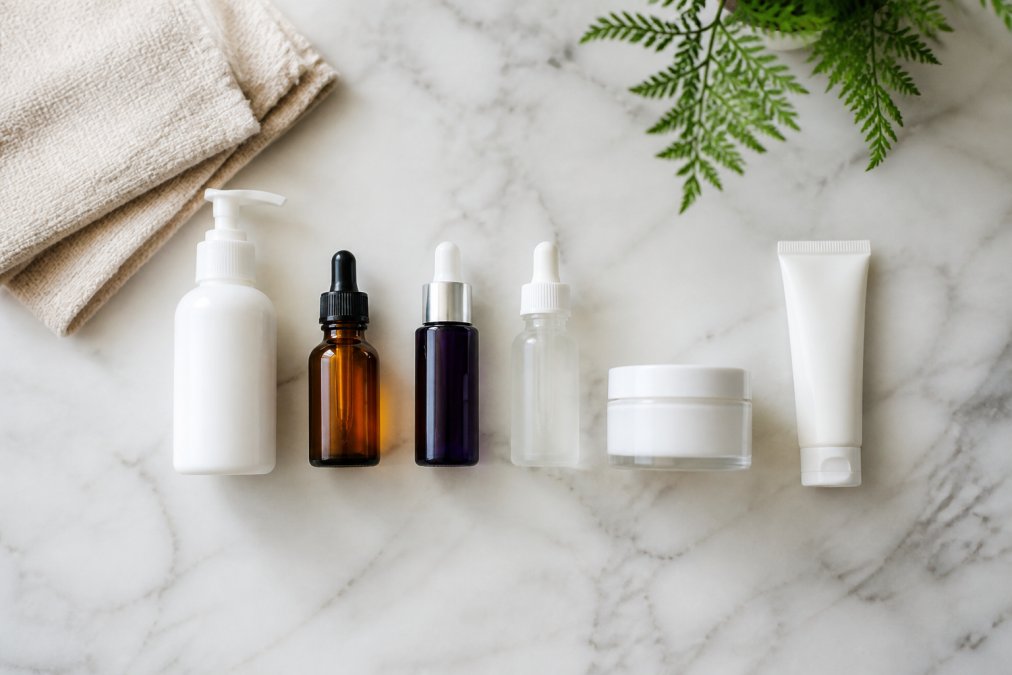
Morning Order
- Gentle cleanser or a rinse with lukewarm water
- Vitamin C serum on dry skin
- Peptide or hydrating serum
- Moisturizer
- Broad-spectrum sunscreen, at least SPF 30
Evening Order
- Gentle cleanser, with a double cleanse if you wore sunscreen or makeup
- Hydrating or peptide serum
- Retinoid, on dry skin
- Overnight moisturizer or repair cream
The most common mistake here is applying retinoid before a serum that contains occlusive ingredients. Retinoids need direct contact with skin to work well, so anything heavy underneath blocks absorption.

Step 1: Gentle Cleansing That Protects the Skin Barrier
Gentle cleansing means removing sunscreen, oil, and debris without stripping the lipids that keep water in your skin. For aging skin, a cream or low-foaming cleanser at a pH-balanced level works better than anything that leaves your face feeling tight.
That tight feeling is not cleanliness. It is barrier damage.
Harsh surfactants lift the natural oils that hold your skin's moisture barrier together. Over time, that raises transepidermal water loss, which shows up as dryness, sensitivity, and more visible fine lines. If your skin stings after washing, the cleanser is the problem, not the rest of your routine.
A practical approach: cleanse thoroughly at night to remove sunscreen, then simply rinse with lukewarm water in the morning. Many people with mature or dry skin do not need a full morning cleanse at all.
PCA SKIN - Pro-Max Age Renewal (1 oz) →
Step 2: Antioxidants and Vitamin C Serum in the Morning
Vitamin C serum in the morning defends against free radical damage from UV exposure and pollution while supporting collagen production and a more even tone. It belongs in the morning routine, under sunscreen, on clean dry skin.
A common mistake is buying a vitamin C product and storing it on a sunny windowsill.
Step 3: Retinoids at Night for Cell Turnover and Collagen
Retinoids at night are the most studied anti-aging ingredient class available, supporting cell turnover, collagen production, and smoother texture over time. They also cause irritation if you rush them.
Step 4: Anti-Aging Skincare Ingredients That Actually Change Skin
The anti-aging skincare ingredients worth your money fall into two groups: ones that signal the skin to rebuild, and ones that repair the barrier so it can. Everything else is marketing.
Peptides, Growth Factors, and Bakuchiol
Peptides and growth factors support the skin's own collagen and elastin processes. Bakuchiol offers retinol-like renewal with far less irritation, which makes it a solid option for anyone who cannot tolerate vitamin A.
Ceramides, Hyaluronic Acid, and Barrier Lipids
Ceramides, hyaluronic acid, and barrier lipids hold water in and keep irritants out. Without them, every active ingredient above works against a weakened barrier.
Step 5: Treating Fine Lines, Deep Wrinkles, and Hyperpigmentation
Fine lines respond to hydration and retinoids. Deep wrinkles and hyperpigmentation need targeted actives plus consistent sun protection, because UV exposure keeps reactivating the pigment your routine is trying to fade.
Two Angles Most Guides Skip
Two factors decide whether your routine works long term, and neither is a product.
Matching Products to Your Main Concern
Use this as a starting point, then adjust based on how your skin responds over four to six weeks.
| Your Main Concern | Product to Start With | Price | Why |
|---|---|---|---|
| Sagging and volume loss | PCA SKIN Pro-Max Age Renewal | $221 | Micro Growth Factor Technology for firmness |
| Retinoid irritation | HYDRINITY RetaXome Daily Retinal Hydrator | $145 | Retinal with reduced-irritation delivery |
| Dryness and dehydration | HydroPeptide Power Luxe | $132 | Bakuchiol plus four hyaluronic acid forms |
| Neck and chest aging | COLORESCIENCE Pep Up Serum | $179 | 10-peptide complex for face, neck, chest |
| Overall texture and pores | Marini Regeneration Booster | $248 | Growth factors, peptides, and ceramides |
| Overnight repair | HYDRINITY CÉLTHERA Repair Cream | $160 | Multi-ceramide barrier blend and NAD+ support |
Frequently Asked Questions
What are the essential ingredients for an anti-aging skincare routine?
Four categories do most of the work: a broad-spectrum sunscreen for photoaging prevention, a retinoid such as retinal or time-release retinol for cell turnover and collagen support, antioxidants like vitamin C for free radical damage, and barrier ingredients such as ceramides and hyaluronic acid. Peptides and growth factors add firmness support. For sensitive skin, bakuchiol offers retinol-like renewal without the irritation. A routine built on those four categories covers fine lines, dark spots, elasticity, and skin hydration without stacking twenty products.

How do I layer skincare products for maximum effectiveness?
Follow skincare routine order by texture: thinnest to thickest. After cleansing, apply watery toners, then treatment serums such as vitamin C in the morning or a retinal hydrator at night, then eye treatment, then moisturizer, and sunscreen last in the daytime. Wait about a minute between steps so each layer absorbs. Keep strong exfoliating acids and retinoids in separate routines unless a professional advises otherwise, and always follow a vitamin A product with sunscreen the next morning.
What is the difference between medical-grade and drugstore skincare for aging skin?
The gap is usually concentration, delivery technology, and testing rather than marketing language. Medical-grade formulas tend to carry higher percentages of active ingredients, use delivery systems designed to push those actives deeper, and publish clinical results. HydroPeptide Collagen ReActivate PM, for example, reports that 91% of participants showed diminished fine lines and smoother texture after eight weeks in a study published in the Journal of Drugs in Dermatology. Drugstore products can still help, but results on deep wrinkles and laxity usually take longer.
How does a skincare routine change as you age?
Three things shift. Collagen production slows, so firmness and volume support become more important than oil control. Cell turnover drops, which makes retinoids and gentle exfoliation more valuable for texture and dark spots. And barrier lipids decline, especially around menopause, so ceramides, squalane, and richer moisturizers move from optional to essential. Transepidermal water loss rises too, which is why a humectant plus a lipid-rich cream beats a lightweight lotion once skin passes 40.
Can a skincare routine really reduce the appearance of wrinkles?
Yes, for surface texture, fine lines, and skin tone, though deep wrinkles respond more slowly. PCA SKIN Pro-Max Age Renewal reports clinically proven improvements in the appearance of lift and firmness and smoother visible lines and coarse wrinkles across a 24-week study, with visible changes starting in as little as one week. Consistency matters more than product count. Sunscreen, a retinoid at night, and daily antioxidant protection are the three steps that move the needle most.